By Nuno Cavaco & Teresa Burton
All About The Topline of a Horse
First and Foremost – What is a TOPLINE!
Topline is the term used to describe –
The muscle groups that run along a horse’s spine and stretches along the vertebral column (spine) from the top of the horse´s neck through the wither area, down the back and loin, and over the top of the hip into the croup region and hindquarters.
The main muscle formation in the topline consists of –
The rhomboideus, splenius, trapezius, longissimus dorsi and gluteal muscles. These muscles enable the horse to collect and extend the neck, lift the shoulder and forehand, flex the back and engage the hind legs.
The only way to build muscle is through an appropriate exercise regime & by providing quality protein rich dietary support together; neither method will work alone.
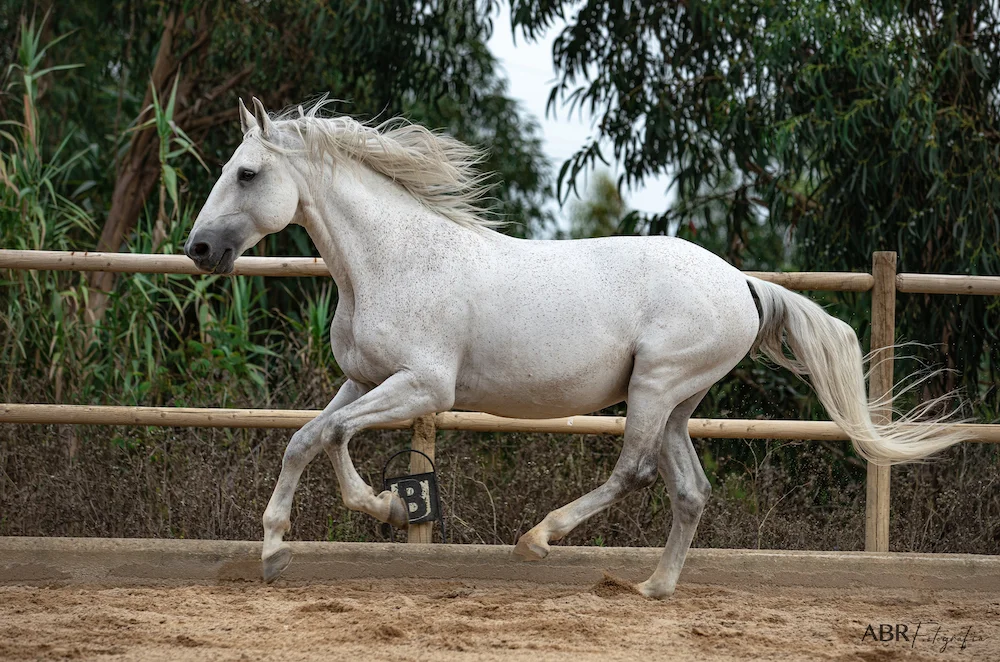
WHAT CAN CAUSE POOR TOPLINE OR TOPLINE PROBLEMS
Your first step when assessing your horse´s condition and topline status is to take into account the whole picture – how he currently looks, his lifestyle, diet, age and training regine.
If your horse is lacking muscle in the withers, back, loin or croup, then some development is needed.
Poor topline muscling can be caused by a number of factors- such as:
- Poor nutrition
- Old age
- Young horses who have not yet fully developed or finished growing
- Lack of movement or turnout
- Lameness
- Poor shoeing and hoof care
- Incorrect saddle fit
- Teeth not managed
- Incorrect way of going
- Musculoskeletal issues such as polysaccharide storage myopathy (PSSM)
- Medical issues (e.g. Cushing’s disease, )
It is important when working with your horse to build his topline that you take a holistic approach – it´s all about the whole horse!
Don’t be tempted to divide your horse into parts, as this generally results in over development in some areas and under development in others. You will find it far more effective to work slowly, precisely and gently. Teaching your horse self carriage and balance during in hand, lunging and ridden work. You are activating him from the back through to the front with keen precision in each exercise, use lots of transitions and lateral work; aim to develop dynamic activity without him racing forward. It is more about him lifting up through the belly which stretches the withers, back, loin right through to the crop area.
We need to create back movers not leg movers, when the horse swings all through the body he becomes supple and athletic, when he is just moving his legs he will become stiff un-supple, his movement flat not dynamic and more than likely he will eventually become unwilling to go forward.
Nuno says building a topline is a daily job, regular gentle work is much more effective than irregular work that is too strong leaving your horse stiff and with painful muscles the following day. Focus on gradually building up, varying the work to keep it enjoyable and interesting.
A horse who works six times a week without ever needing to engage his back will show less topline muscle than a horse who works three times in a week correctly.
Developing muscles with the young horse starts with the goal to get them to stretch their frame on the lunge. The aim is for them to stay long and low, the head and neck never coming above the horizontal line. They learn to maintain a steady regular rhythm, balance and activity up and down through transitions on both reins. The purpose is to gradually go from long and low to collected later in his development.
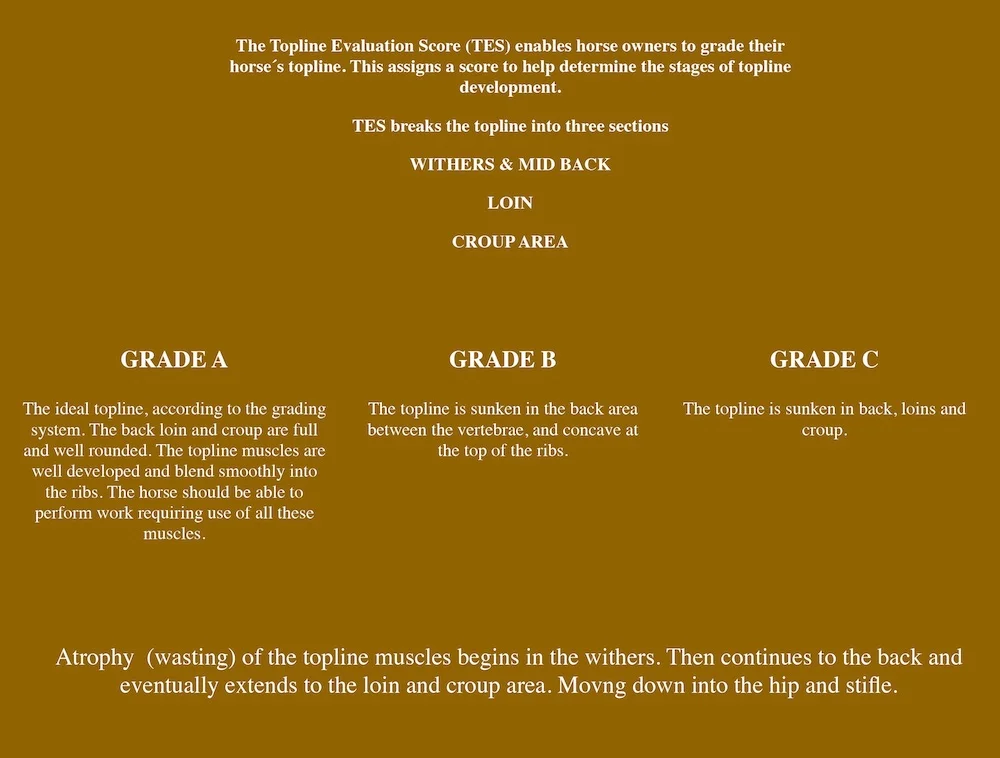
In Hand Work -Why use lateral work in hand to build the top-line ?
When considering topline lateral work has huge benefits. By training your horse to move laterally you are teaching him greater levels of balance – as lateral is not a natural movement for them.
In learning to re balance themselves they work their muscles differently thus the muscles become more supple and athletic. They stretch both sides of their body and their upper line.
If you are new to in hand work We highly recommend our series of Ín Hand´ Articles which take you right from getting started right up to advanced dressage exercises.
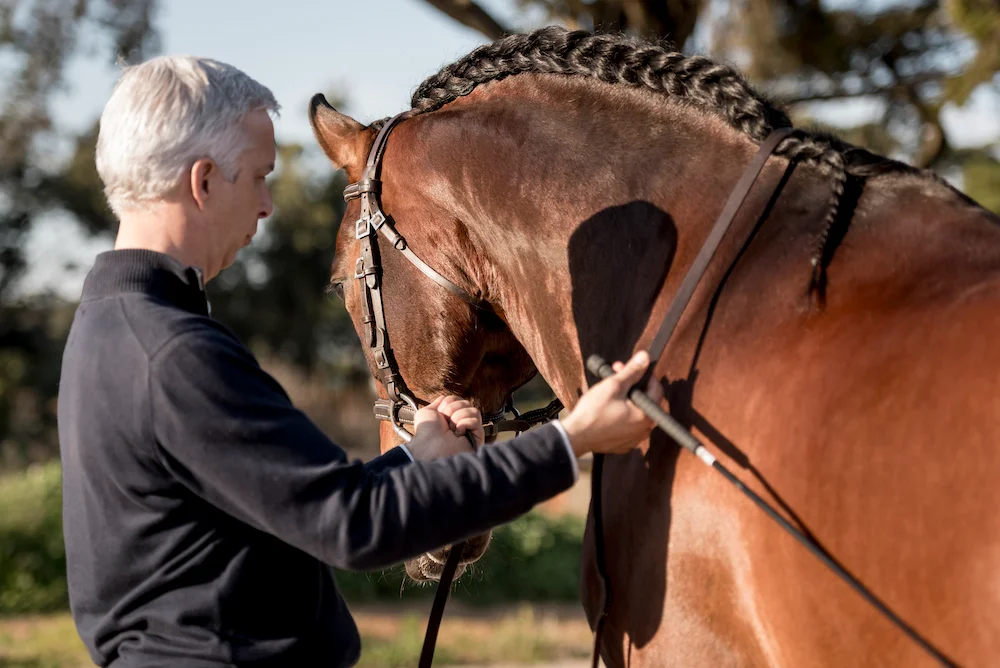
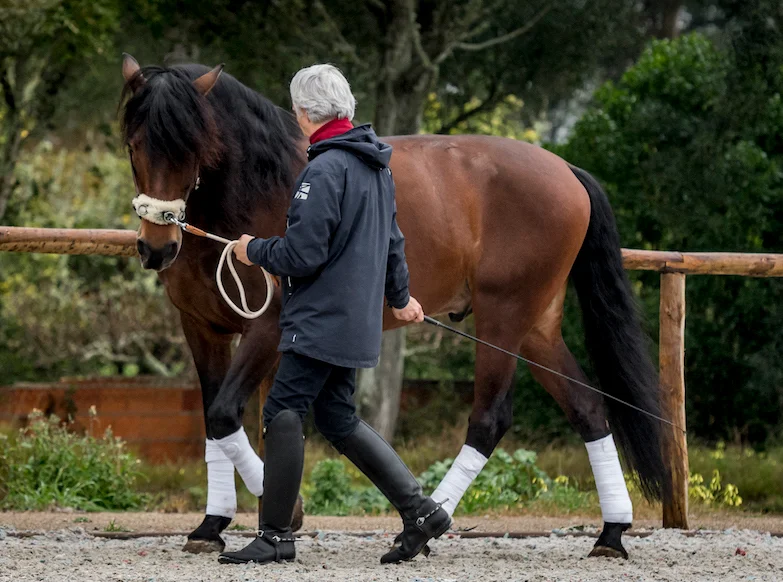
Nuno with Acarus
This shows Acarus´s neck line from withers and head position. Nuno is asking him the gently accept the bit while maintaining a vertical line in the front of the head. Nuno´s aim is to improve the contact without a rider.
Nuno is taking a moment to assess Acarus´s total outline how he is holding himself, how he is accepting a light contact, slight inside bend, his muscles and frame also his acceptance to Nuno as his leader.
Photo Nuno with Acarus
In this image Nuno is working Acarus in ´shoulder in´ on the long side of the arena. You can see in the image that Acarus is stretching all of the outside of his body whilst lifting and contracting the inside. As his inside hind leg passes under him he lifts his belly upward which stretches the upper line and strengthening his belly muscles. Maintaining a flowing and supple movement is vital to achieve the best results.
NB We highly recommend that when beginning any work especially if you are new to it that you seek a professional trainer and advise. It is so important to be sure you are doing the exercises correctly to achieve the best results. Lets face it in reality it is no different to when we embark of our own training programme with a personal trainer. The trainer can show us where we can improve, perfect our exercises and avoid injury. There many way to access quality training now from finding a trainer in your local arena to online live coaching so there really is no reason the struggle alone.
Images by Bruno Barata.
Ridden Work
Transitions
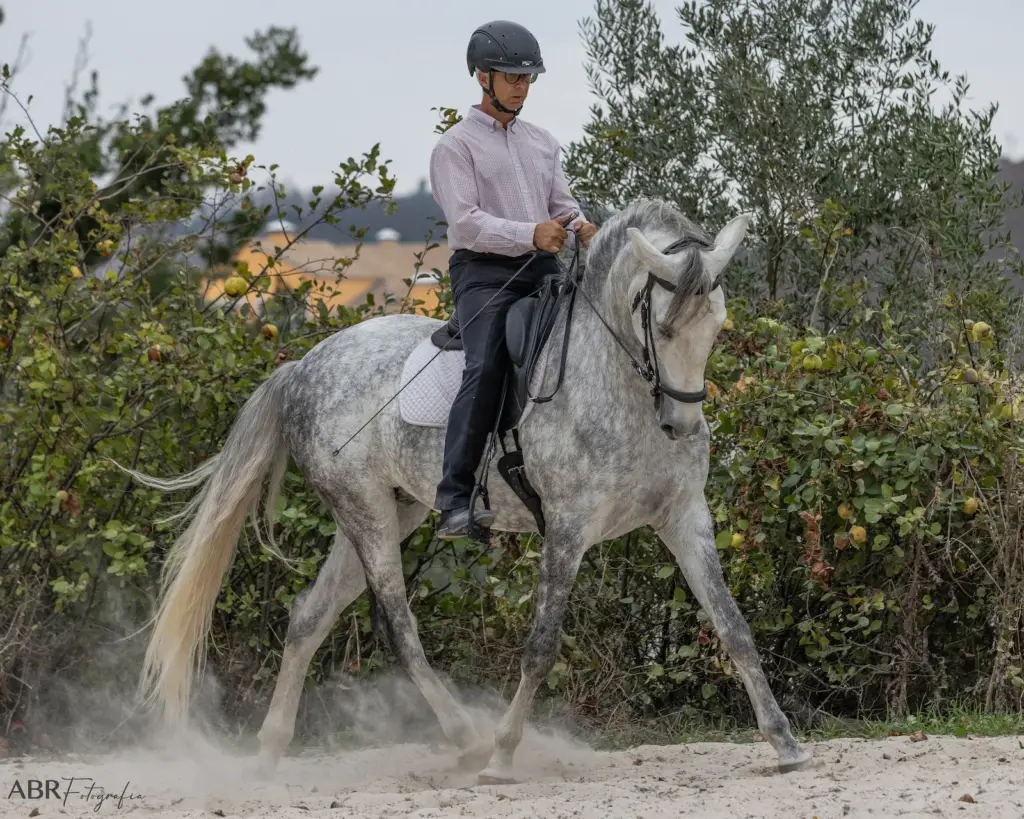
Transitions are essential to help your horse to use their entire body, building strength and balance by engaging the hindquarters, lifting the back and neck.
Whether ridden or on the lunge time spent working on transitions – downward or upward, between the pace or within the pace – is very rarely time wasted!
Transitions make the horse responsive, a more dynamic listener to you. Sometimes horses tend to go on automatic pilot and it feels like they don’t hear your aids. However, if you do a transition before your horse gets to that point, it gives him something to pay attention to. Therefore he will stay activate and engaged behind. Make it fun surprise him by introducing transitions in many different places even out hacking. Include rein back.
Plenty of transitions make the horse supple. When performing transitions with bend on a circle, say between working trot and collected trot or between working trot and lengthened stride, the horse naturally balances back on the hindquarters as he retains the bend. The horse learns that he can slow down by bringing the hindquarters under.
When doing this on the lunge you can clearly see what happens in the up and down transitions. Look at what happens in the hind quarters does your horse push off from the hind quarters. Look at his head and neck does it stay steady or is it jerking up especially in the upward transitions. If it is doing this he is not pushing from behind. You can practise doing transition every full circle, every half circle and even every quarter cirlce up and down. This will really activate the hind end and encourage your horse to actively listen you. When they are pushing from behind they raise their belly and therefore stengthen and muscle the topline.
Long and low
Riding your horse in a long and low frame, where they are correctly seeking the contact and working over the entire topline in a “stretchy” frame is a great way to build topline muscle which isn’t tight or sore.
This is because it uses the croup, wither, shoulder, hind end, back, and neck all at once and helps the horse to “swing” and release the muscles. It also forms the basis of a good connection, and can help you to ride your horse into a good uphill frame once they are ready.
Rein back
Rein back, or backing up, is another exercise which is very useful to develop topline. If your horse can’t do it under saddle yet, you can do this on the ground a few times a week.
When the horse backs up (as long as they don’t hollow and use the neck to brace when doing so), the hind end comes further underneath him and encourages him to engage his core and take more weight behind.
Initially, a few steps will be enough. Over time, you can add more steps and can even incorporate rein back on hilly ground. Rein back is also very effective performed in Ín Hand´work See our articles on this work.
Hill work and hacking out
Working up and down hills helps your horse to use all his muscle groups and increases the strain they are under. Just like you work harder walking up a hill than on level ground. It’s a great way to help him engage the hindquarters and strengthen the back and pelvis areas. Initially, walking and a slow trot and gradually build up.
Going downhill is just as beneficial as uphill – both encourage your horse to use their topline in a natural way. As your horse’s balance and strength improves, you can even trot or canter downhill. This activity you can even do this on a lunge line out in a field. It greatly improves your horse´s confidence on different surfaces. Read about Riding Out Tips
Polework and cavaletti
Using poles, cavaletti, and small jumps in your horse’s work is a good way to build topline.
To engage the hindquarters and strengthen the back and pelvis areas. Start with walking and a slow trot gradually build up.
They help your horse to use their body correctly by encouraging increased hock and hind leg activity and a raised, lifted back. You’ll often find your horse will stretch their necks down to balance over poles, this should be encouraged.
There are hundreds of different exercises you can do, as simple as walking poles on a circle or as complex as fans and other shapes with transitions. You will find many exercises shown on youtube.
Turnout
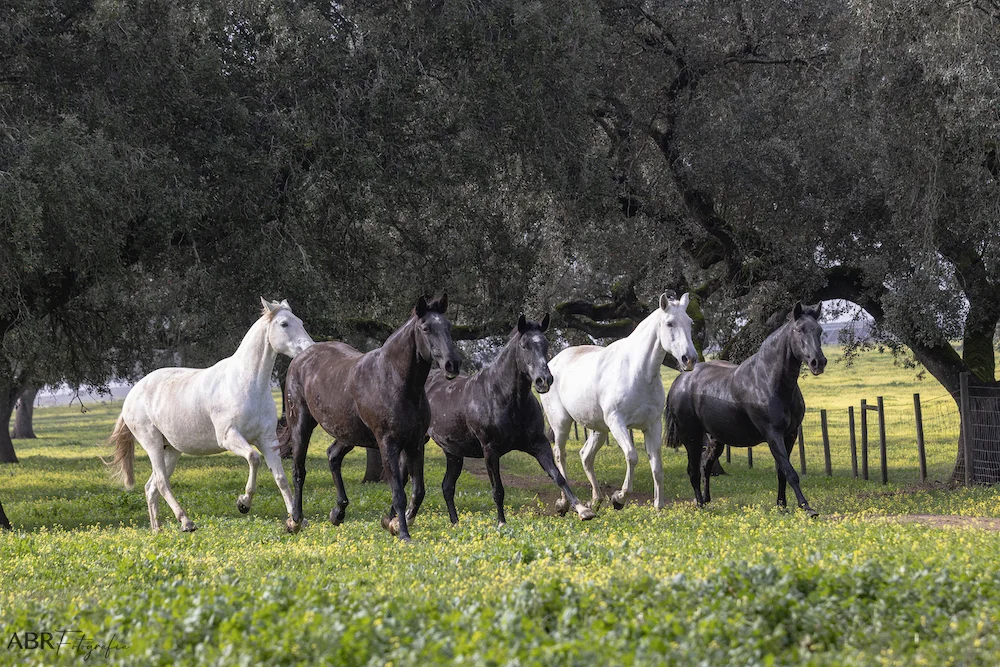
Where you can maximise turnout as much as possible, so your horse moves around more. If you have access to turnout which has hills or uneven terrain, that’s even better! Horses that can move around all day or at least for part of the day( if your turnout is limited) will be able to maintain a healthy level of natural muscle tone. They are more mentally balanced and healthy. Turnout can help to reduce the risk of colic and swollen limbs, joint and muscle aches. Also maintain healthy tendons.
Diet and Nutrition
Just like us humans in order to build muscle and improve body condition horses need the right balanced diet. They cannot effectively develop muscle tone without good nutrition and time to rest and recurperate. A balanced nutrition programme should be matched to suit their body condition and training programme.
The horses´ topline is the muscle that supports and protects the spine. These muscles along the back neck to hind quarter play a vital role in your horses performance, how he looks and feels. Even his energy.
It may seem odd but a horse can be fit and even fat and not have a topline. So what is needed for muscle development ?
includes the right In addition to giving your the correct work and a quality protein rich diet with the right amino acids, you can also help your horse’s topline development by making a few adjustments to their routine.
Exercise activates muscle conditioning and the development process WHILE, nutrition provides the building blocks in the form of amino acids that make up to protein.
After training we benefit from eating protein to aid muscle repair, this is the same principle for horses. Using feeds with protein such as legumes, young grass pastures, soybean meal, canola meal, and linseed meal builds and repairs muscle.
Soybean meal is rated the highest quality due to the amino acid profile being superior to most other plant products. Moderate to low quality protein include cereal grain.
Hays – the best for protein are the lucernes with the highest protein level. The build muscle your horse needs all amino acids which their bodys cannot make.
- Lysine – suits all horses and especially young horse growth.
- Threonine – all horses and especially older horses in repair and malnutrition.
- Metionine – for hoof and hair growth
- Valine, Leuine and Isoleucine – these are branch chain amino acids important for muscle recovery
- Phenylalanine – a building block for proteins and a precursor to neurotransmitters
- Arginine and Histidine – these are used in protein biosynthesis
For feeding Lusitanos see Articles by Dr Joao Crespo
Again, like humans, when a horse is younger, the rate of muscle protein synthesis is fastest during growth, and synthesis rates decline as the animal ages. If there is an inadequate amount of any of these essential amino acids in a horse’s diet, protein synthesis will only occur to the level of the limiting amino acid. For example, if a
diet contains 125% (of what the horse needs in) lysine, 110% methionine, 101% threonine, and 80% tryptophan, then the horse will synthesize all the amino acids into protein at 80% of its potential.
For horses in an intense level of training, it is most likely you will need to double protein requirements.
We highly recommend you obtain advise from your equine nutritionist or vet
A lot of this might seem rather complicated, and you can go in-depth to the scientific reasoning behind it all. Essentially if you speak to a trusted equine nutritional supplements company and/or your quality horse feed company they can work a complete diet to suit your horse’s needs. There are many fantastic supplements and feed specially designed and formulated with all the hard work already done for you.
Saddle Fit
Imagine you invest all the time and effort in your horse´s training programme, diet, teeth and hoof care but your saddle doesn´t fit correctly. All your good work can go to waste and the back muscles are damaged causing pain and muscle atrophy. This can show all through his body poll to tail and down the legs.
So how do you know that the saddle is fitting well and your horse´s development is showing that the saddle is not causing any problems?
1. The shoulder blade has come up and back is wider and very defined.
2. He has a well muscled neck, stronger on top (poll to withers) likewise the jaw where the neck transitions into the pectorials.
3. The trapezius is well developed and well, defined behind the shoulder blade.
If your horse is exhibing pain in the back or hind end and can manifest in the poll this can be your saddle fit. When a horse is experiencing discomfort or pain as the training progresses, it could indicate that the saddle fit is no longer appropriate for the new muscle they have.
In fact it is very important to note that there is no doubt that as the horse progresses in correct gymnastic training the saddle support area size changes!
Therefore you need to be mindful to keep up with these changes and have your saddle fitter regularly assess the fit and make the required adjustments as the muscle develops.
There are many top master saddler available to support you and your horse in your progress. The saddle must work for you also. Your riding position, body straightness and lightness all play a vital part in helping your horse.
Article by Teresa Burton with imput from Nuno Cavaco.
Images of Acarus by Bruno Barata
Images Ridden and in fields – ABR fotos